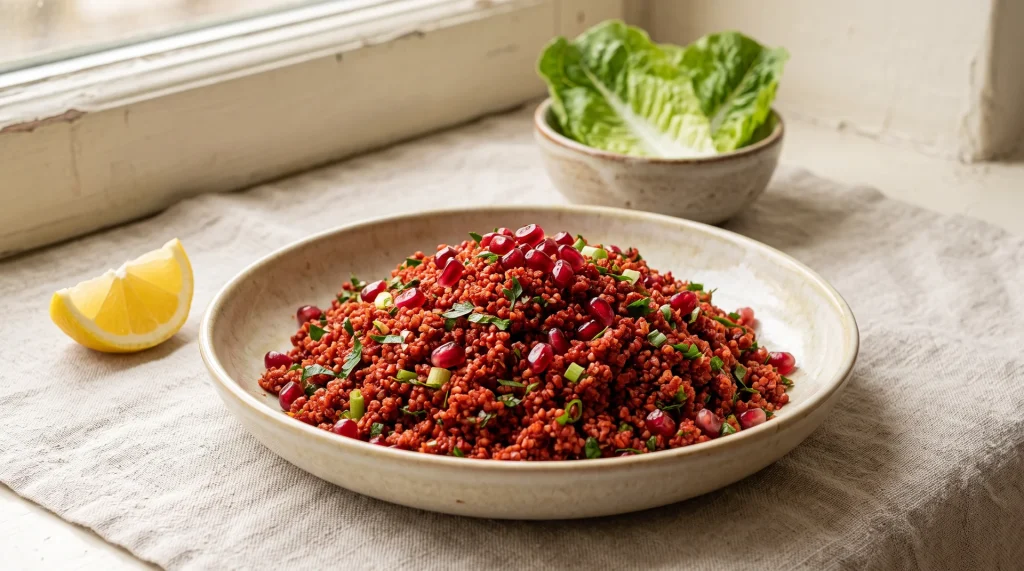
Kısır is the fine-bulgur salad that shows up at every gathering in southern Turkey — dressed in tomato and pepper paste, not olive oil and herbs alone. Here’s what it is, how it differs from tabbouleh, and a recipe that needs no stove.
What Kısır Is
Kısır is a bulgur salad built on fine-grind bulgur, softened with hot water rather than boiled, then worked with tomato paste and pepper paste until every grain is coated a deep, rusty red. Onion, herbs, and chopped vegetables go in after, but the paste is the backbone — it’s what separates kısır from a plain grain salad.
The dish is strongly associated with southern Turkey, and especially with Antakya and the wider Hatay region, where pepper paste and tomato paste are pantry staples rather than occasional ingredients. Families there keep opinions about the right ratio of tomato to pepper paste, the right amount of onion, and whether pomegranate molasses belongs in the bowl. There’s no single correct recipe — there’s a shared method with a hundred household variations.
The grind is the one thing worth being strict about: fine bulgur softens completely in hot water and holds a dressing without going soft, which is exactly what this salad asks of it.
Kısır vs. Tabbouleh
Kısır and tabbouleh get confused constantly, and the confusion is fair — both are cold bulgur salads eaten across the eastern Mediterranean. The difference is in the ratio and the dressing.
Tabbouleh is herb-forward: a Levantine salad built mostly from finely chopped parsley and mint, with a small amount of fine bulgur mixed in almost as a binder, dressed simply in lemon juice and olive oil. Kısır flips that ratio. Bulgur is the base, not the accent, and the dressing is built on tomato paste and pepper paste before the lemon and olive oil go in. The herbs matter in kısır, but they season the dish; they don’t define it the way parsley defines tabbouleh.
Texture follows the same logic. Tabbouleh reads bright and green. Kısır reads deep red-orange, denser, and more savory — closer to a seasoned grain than a chopped herb salad. If you’ve had one and not the other, expect kısır to taste more like a meal and less like a garnish.
The Recipe
This is the no-boil method most Turkish home cooks use for fine bulgur: hot water and a covered bowl do the cooking. No stovetop simmering required.
Ingredients (serves 4 to 6 as a side)
- 1 cup (about 6 oz.) fine bulgur
- 1 cup boiling water
- 2 tablespoons tomato paste
- 1 tablespoon pepper paste, plus more to taste
- 3 tablespoons olive oil
- 2 tablespoons fresh lemon juice
- 1 small onion, finely diced
- 1 teaspoon salt, plus more to taste
- 1/2 teaspoon ground cumin
- 1 large tomato, finely diced
- 3 scallions, thinly sliced
- 1 cup flat-leaf parsley, finely chopped
- 2 tablespoons fresh mint, finely chopped
- 1 tablespoon pomegranate molasses (optional)
- Romaine or gem lettuce leaves, for serving (optional)
Method
- In a large bowl, stir the tomato paste and pepper paste into the boiling water until dissolved. Add the bulgur, stir once to distribute the paste evenly, cover the bowl, and let it stand for 15 to 20 minutes. This is the entire cooking step — the hot water softens fine bulgur completely on its own.
- Fluff the bulgur with a fork. It should be tender with a slight chew, not mushy. If any water remains unabsorbed, let it sit a few minutes longer.
- While the bulgur is still warm, stir in the olive oil and lemon juice. Warm bulgur absorbs dressing better than cold.
- Add the onion and the teaspoon of salt, and toss well. Letting the salted onion sit in the warm bulgur for a few minutes softens its raw bite — a small step that makes a real difference.
- Fold in the cumin, tomato, scallions, parsley, and mint. Add the pomegranate molasses, if using.
- Taste and adjust — more lemon for brightness, more pepper paste for depth, more salt if the vegetables have diluted it.
- Let the salad rest for 10 minutes before serving so the flavors settle. Serve at room temperature or chilled, scooped onto lettuce leaves in the traditional style, or on its own as a side.
Make-Ahead Notes
Kısır keeps well because the bulgur is meant to absorb the dressing over time — it’s a better make-ahead dish than most salads. Store it covered in the refrigerator for up to four days. The color deepens and the flavor rounds out after a day, so making it the morning of a gathering, or the night before, generally improves it. Add fresh herbs and a squeeze of lemon just before serving if the salad has been resting more than a day, since chopped herbs lose some brightness in the fridge.
Variations
Coarse bulgur works if fine isn’t on hand, but it needs a longer soak — closer to 30 minutes — and the result reads heartier and less traditional. Some cooks add finely diced cucumber or bell pepper for crunch; others skip the tomato altogether and let the paste carry all the color and moisture. Walnuts add texture and protein. For a version with more heat, use hot pepper paste in place of sweet, or blend the two.
FAQ
Is kısır served cold?
Kısır is usually served at room temperature or chilled, never hot. It’s a make-ahead salad by nature — the bulgur keeps absorbing the dressing as it sits, which is part of why it tastes better the next day.
What’s the real difference between kısır and tabbouleh?
Ratio and dressing. Tabbouleh is a parsley salad with a little bulgur mixed in, dressed in lemon and olive oil. Kısır is a bulgur salad dressed in tomato paste and pepper paste first, with herbs added for seasoning rather than volume.
How long does kısır keep in the fridge?
Up to four days, covered. The flavor improves over the first day as the bulgur absorbs the paste and lemon; add fresh herbs before serving if it’s been more than a day.
Is kısır gluten-free?
No. Bulgur is made from wheat, so kısır contains gluten and isn’t suitable for anyone with celiac disease or a gluten intolerance.
Can I make kısır ahead for a party?
Yes — it’s one of the better dishes to make a day in advance. Hold back the fresh herbs and a final squeeze of lemon, and add both right before serving to keep the color and flavor sharp.
Keep Reading
How to use Turkish pepper paste — what biber salçası is and eight ways to cook with it. And bulgur vs. quinoa, an honest comparison for anyone deciding which grain belongs in the pantry.
Leave a Reply
You must be logged in to post a comment.