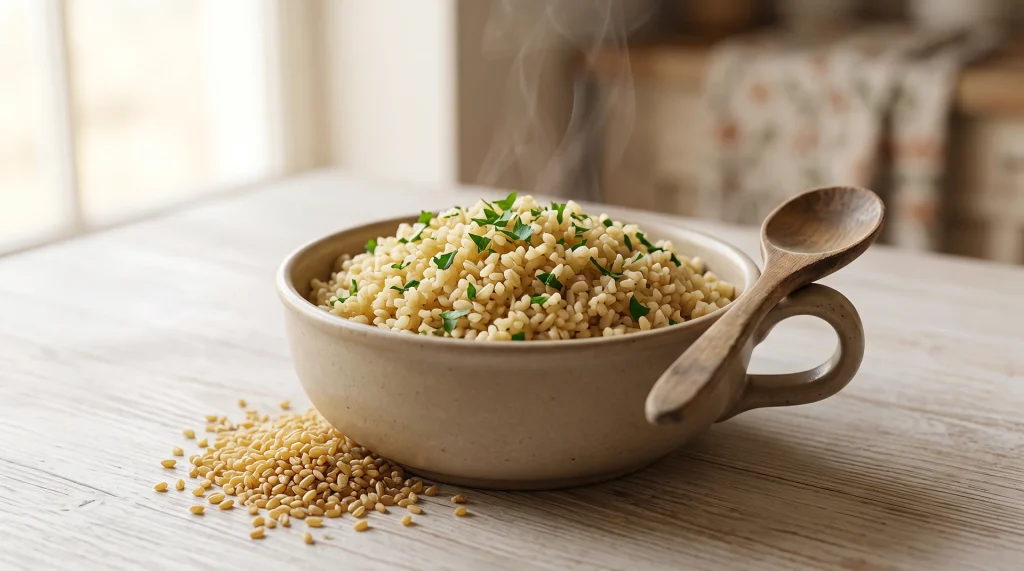
Both are whole-grain pantry staples with loyal followings, and neither one needs to lose for the other to win. Here’s a plain comparison of protein, fiber, cook time, cost, flavor, and who should reach for which.
The Nutrition, Side by Side
Per cooked cup, unsalted, the two grains land close to each other, with real differences worth knowing.
| Bulgur | Quinoa | |
|---|---|---|
| Calories | ~151 | ~222 |
| Protein | ~5.6 g | ~8.1 g |
| Fiber | ~8.2 g | ~5.2 g |
| Carbohydrates | ~34 g | ~39 g |
| Fat | ~0.4 g | ~3.6 g |
Quinoa wins on protein, and it’s a genuinely complete protein — it carries all nine essential amino acids, which is unusual for a plant food and part of why it earned its reputation. Bulgur wins on fiber by a wide margin, largely because it’s a cracked whole wheat kernel with the bran still intact. Neither number makes the other grain a poor choice; they’re just built differently, one leaning toward protein density, the other toward fiber.
Nutrition figures per cooked cup, from USDA FoodData Central: Bulgur, cooked (FDC #170287) and Quinoa, cooked (FDC #168917).
Cooking: Time, Effort, and What Goes Wrong
This is where the two diverge the most. Fine bulgur needs no boiling at all — cover it in hot water, let it stand 15 to 20 minutes, and it’s done, which is the entire method behind kısır. Coarse bulgur simmers for about 12 to 15 minutes, closer to rice.
Quinoa needs a rinse before cooking, to wash off the saponin coating that tastes bitter if skipped, then a 15- to 20-minute simmer. Both grains are genuinely quick by whole-grain standards — this isn’t a case of one being fast and the other slow, just two different rhythms.
Cost and Sourcing
Bulgur tends to run cheaper per serving at retail, since it’s a simply processed wheat product — parboiled, dried, and cracked, without the extra steps quinoa needs. Quinoa is grown mostly in the Andean highlands of Peru and Bolivia, and global demand over the past two decades has pushed prices up, both for export and, at times, for the farmers who grow it locally. That history is context for the price gap, not a reason to avoid quinoa — both are honest, minimally processed staples.
Flavor and Texture
Bulgur is nutty and wheat-forward, with a tender chew that takes on whatever it’s cooked or soaked with — this is why it works so well against a strong dressing like tomato and pepper paste in kısır. Quinoa has a lighter, slightly grassy flavor and a distinctive texture: each grain stays separate and shows a small curled tail once cooked, giving it a gentle pop that bulgur doesn’t have. Neither is more or less flavorful; they behave differently in a bowl.
The Gluten Question
Bulgur is a wheat product and contains gluten. It is not safe for anyone with celiac disease or a diagnosed gluten intolerance. Quinoa is a seed, not a grain in the botanical sense, and it’s naturally gluten-free, which makes it one of the more reliable whole-grain substitutes for anyone avoiding gluten. If gluten is a concern in your kitchen, quinoa is the clear choice between these two — this is the one place where the comparison isn’t close.
When to Choose Which
Reach for bulgur when a recipe calls for a starch that absorbs a bold dressing — kısır, tabbouleh, pilafs cooked with tomato paste, or stuffed vegetables. Reach for quinoa when gluten is off the table, when a recipe wants distinct, separate grains rather than a soft absorbent one, or when protein density matters more than fiber for a given meal.
Substituting One for the Other
Quinoa in place of bulgur: cook it first — rinse, simmer, cool — then use it wherever a recipe calls for cooked bulgur. Expect a firmer, more separate grain that holds less dressing, so add a little extra oil or lemon to compensate. This is the move if you’re making a gluten-free version of a bulgur salad.
Bulgur in place of quinoa: fine bulgur works with the no-boil method for a quick swap in cold salads; coarse bulgur, simmered, is closer to quinoa’s texture in a warm pilaf. Either way, expect a softer, starchier result — bulgur doesn’t hold its shape the way quinoa’s grains do.
Coarse or Fine — Choosing the Right Bulgur
Once bulgur wins the choice, the grind matters as much as the grain. Fine bulgur is the grind for cold salads — kısır and tabbouleh — because it softens fully in hot water alone and holds a dressing without turning soft. Coarse bulgur is built for pilafs, soups, and stuffed vegetables, where a heartier bite and a short simmer make more sense than a soak.
FAQ
Is bulgur healthier than quinoa?
Neither is healthier across the board. Quinoa has more protein and is a complete protein; bulgur has more fiber and fewer calories per cup. Which one serves you better depends on what you’re eating it for.
Can people with celiac disease eat bulgur?
No. Bulgur is made from wheat and contains gluten. Quinoa is naturally gluten-free and is a safe substitute for anyone avoiding gluten.
Is quinoa technically a grain?
Not botanically — it’s a seed, often called a pseudo-cereal, but it’s cooked and eaten like a grain and compared to grains for that reason.
Which one cooks faster?
Fine bulgur is the fastest of the two, since it needs no boiling — just a hot-water soak. Coarse bulgur and quinoa both take roughly 12 to 20 minutes on the stovetop.
Can I combine bulgur and quinoa in the same dish?
Yes. Cooking them separately and folding them together works well in a grain salad, combining quinoa’s protein and texture with bulgur’s fiber and chew — just note the dish is no longer gluten-free once bulgur is in it.
Keep Reading
What is kısır for the classic fine-bulgur recipe, and how to use Turkish pepper paste for the paste that seasons it.
Leave a Reply
You must be logged in to post a comment.